After 11 Years in Korea, a Cultural Experience Becomes an Award-Winning Achievement
Promoting Ghana–Korea Exchange Through K-Beauty
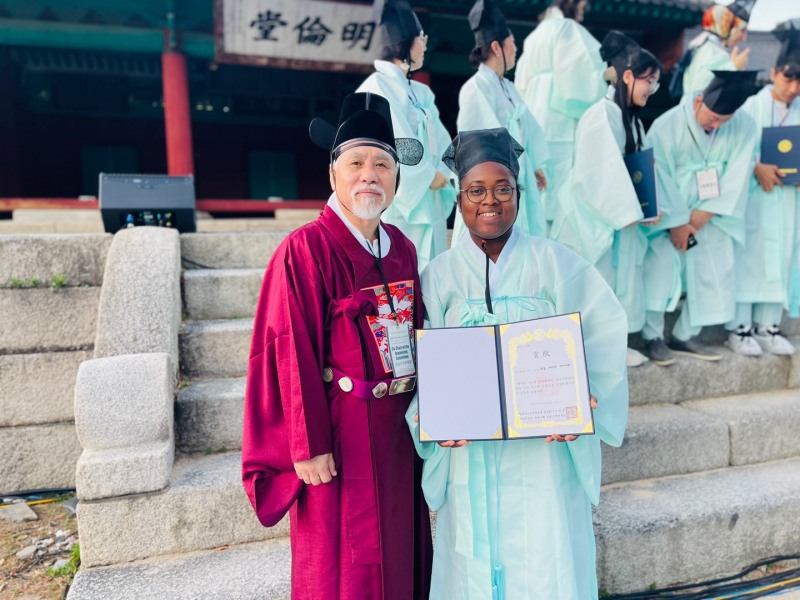
Ghanaian national Hato Anita Emefa (right) poses with a representative of the organizing committee after receiving the Byeonggwa (丙科) Third Prize at the inaugural Foreign Residents’ Gwageo Examination, held at Sungkyunkwan in Seoul on October 5, 2026. The event offered foreign residents an opportunity to experience Korea’s traditional civil service examination system. (Photo courtesy of Hato Anita Emefa)
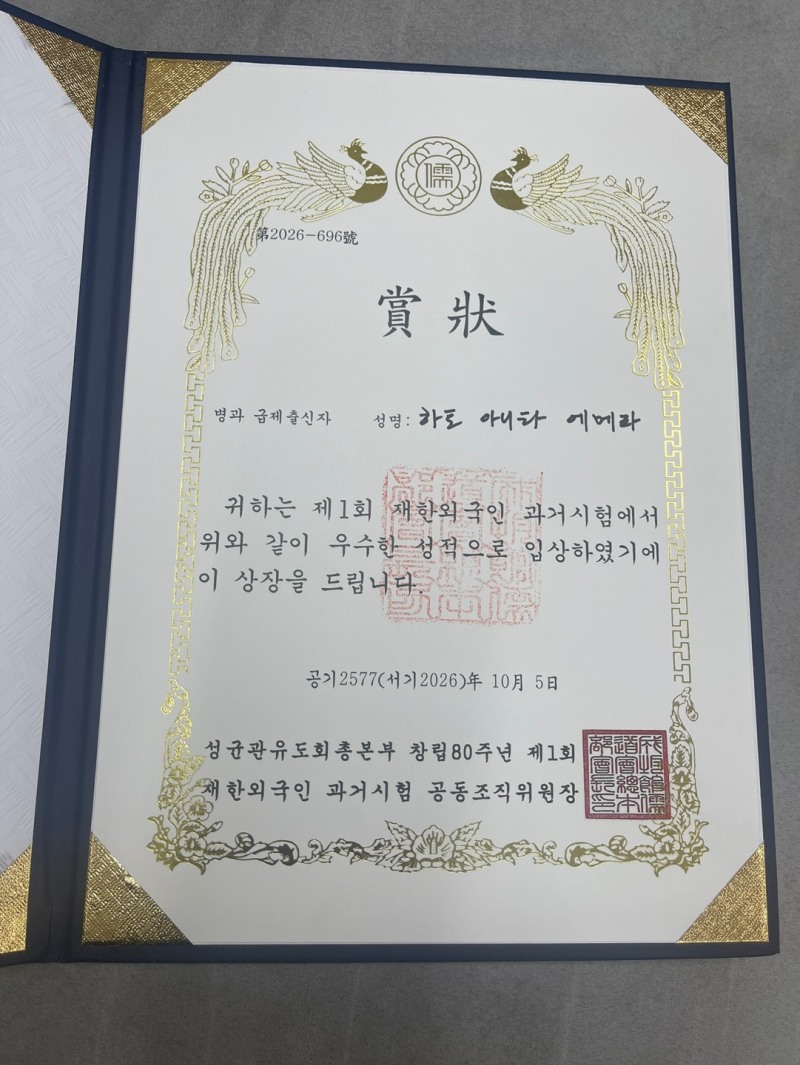
[비욘드포스트 황상욱 기자] Hato Anita Emefa, a Ghanaian national who has lived in South Korea for more than 11 years, received the Byeonggwa (丙科) distinction at the First Civil Service Examination for Foreign Residents in Korea, held on October 5 at Sungkyunkwan in Seoul.
Organised to commemorate the 80th anniversary of the Sungkyunkwan Confucian Association, the event offered foreign residents an opportunity to experience Korea's traditional civil service examination system. Approximately 200 participants from 55 countries gathered at the historic Myeongnyundang and Bicheondang halls of Sungkyunkwan in Jongno-gu, Seoul.
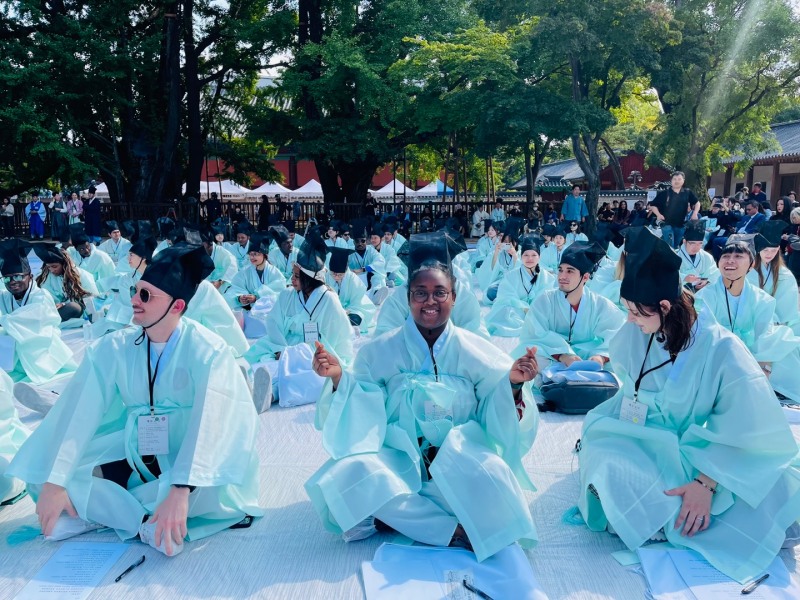
Dressed in traditional scholar's attire, participants recreated the examination practices of the Joseon Dynasty by writing their answers in Korean using traditional brushes. The examination invited participants to identify three aspects of Korean culture they would like to introduce to their home countries and explain their choices. The event also featured traditional games, cultural performances, and other activities celebrating Korea's heritage.
Among the award recipients was Hato Anita Emefa, who has lived in Korea since 2015. Having worked in education, she now operates Pibu Chingu, a K-beauty business seeking to connect Korean beauty brands and innovations with consumers and professionals in Ghana and other African markets.
Following her achievement, Emefa shared her reflections on the examination, her experiences living in Korea, and her aspirations for strengthening cultural exchange between Ghana and Korea.
Ghanaian national Hato Anita Emefa (center) poses with fellow participants during the inaugural Foreign Residents’ Gwageo Examination, held at Sungkyunkwan in Seoul on October 5, 2026. Dressed in traditional Korean attire, participants experienced a reenactment of Korea’s historic civil service examination. Emefa was awarded the Byeonggwa (丙科) Third Prize. (Photo courtesy of Hato Anita Emefa)
**Q. What inspired you to participate in the examination, and how did you feel when you learned that you had received an award?**
I first came across the announcement on Instagram and immediately found it interesting. Having lived in Korea for more than 11 years, I have learned a great deal about Korean history and culture, but I had never had the opportunity to experience a traditional civil service examination firsthand.
I honestly had no expectations of winning. I simply wanted to challenge myself, enjoy the experience, and learn more about Korea's cultural heritage.
When my name was announced among the award recipients, I was genuinely surprised and delighted. Receiving the Byeonggwa distinction made the experience even more special and meaningful.
**Q. What was the most memorable part of the examination?**
One of the most meaningful moments was learning about the Rules of the White Deer Grotto Academy (Baengnokdonggyu, 白鹿洞規) and Confucian teachings before the examination.
I was particularly impressed by the five principles of learning: studying broadly, inquiring deeply, thinking carefully, discerning clearly, and practising earnestly.
The emphasis on integrity, sincerity, doing what is right without seeking personal gain, and treating others with respect strongly resonated with my personal values.
I believe that if these principles were genuinely practised in our societies and business relationships, we could build more harmonious communities.
Wearing traditional scholar's attire and attempting to write with a brush within just 20 minutes was also a memorable experience.
What made the event particularly meaningful was the opportunity to participate in Korean history rather than simply observe it. Cultural heritage can be preserved not only through museums and historical records, but also through experiences that allow people to engage with it directly.
**Q. You selected K-beauty, Korean food, and traditional Korean music as three aspects of Korean culture you would like to introduce to Ghana. Why did you choose them?**
These are three aspects of Korean culture that I have come to appreciate during my years here.
K-beauty was my first choice because it connects both my personal interests and my professional work. Through my company, Pibu Chingu, I am working to introduce Korean beauty brands, skincare products, and innovations to Ghana and other African markets.
I particularly admire Korea's emphasis on consistent skincare routines, product innovation, and maintaining healthy skin.
I also love Korean food, especially the variety of side dishes, or banchan, served with a meal. The combination of vegetables, flavours, textures, and different preparation methods is fascinating.
Traditional Korean music was my third choice. I find the sounds of Korean traditional instruments beautiful and sometimes very calming.
Music can communicate a country's history, emotions, and cultural identity even when people do not share the same language.
I hope these aspects of Korean culture will help Ghanaians develop a deeper understanding of Korea beyond its internationally popular entertainment.
**Q. Having experienced both cultures, what similarities and differences have you noticed between Ghana and Korea?**
Although Ghana and Korea are geographically far apart, they share several important cultural values.
Both societies place great importance on family, community, and respect for elders. The way we address older people and express respect through our words and actions carries significant meaning in both cultures.
Sharing food is another similarity. In Ghana, just as in Korea, sharing a meal is an expression of hospitality, care, and belonging.
One of the biggest differences I noticed when I first arrived was Korea's famous *ppalli-ppalli*, or "hurry-hurry," culture.
In Ghana, daily life can sometimes move at a more relaxed pace, whereas in Korea, everything seems to happen quickly, from deliveries to administrative services.
It took some time to adjust, but I have come to appreciate the efficiency and convenience of Korean society. (Laughs)
Living between these two cultures has taught me that different ways of doing things are not necessarily better or worse. They reflect different histories, values, and ways of life.
**Q. How did your connection with Korea begin, and how has living here influenced your life?**
My journey with Korea began in 2010 when I first visited through an exchange programme. I returned for short visits in 2012 and 2014 before moving to Korea in August 2015 to pursue a master's degree in Educational Technology at Ewha Womans University.
Since then, I have worked in education, built meaningful friendships, started a family, and eventually established my own business.
Of course, there have been challenges, including language barriers, cultural differences, and adapting to unfamiliar systems.
However, those experiences have taught me patience, adaptability, independence, and, most importantly, resilience.
What began as an undergraduate exchange experience has become an important part of my life. Today, I am a wife, mother, entrepreneur, and permanent resident of Korea.
Living here has broadened my perspective and helped me appreciate different ways of thinking and solving problems. At the same time, it has made me even more conscious of the importance of my Ghanaian identity and cultural roots.
**Q. What does this award mean to you personally, and what are your plans for promoting cultural exchange between Ghana and Korea?**
This award means much more to me than a personal achievement. It has given me an opportunity to reflect on how profoundly my experiences in Korea have influenced the direction of my life.
What makes it particularly meaningful is that the examination topic was closely related to the work I am already doing.
Through Pibu Chingu, I am working to build connections between Korea and Ghana through K-beauty and business. Looking ahead, I believe there are many opportunities to expand cooperation into other areas, including food and education.
For me, meaningful cultural exchange goes beyond introducing people to different traditions.
It is about building genuine relationships, promoting mutual understanding, and creating opportunities that benefit both countries.
I hope to continue participating in activities that encourage people in Ghana and Korea to learn from one another.
**Q. Finally, what message would you like to share with fellow Ghanaians and other foreign residents in Korea? What aspects of Ghanaian culture would you like to introduce to Koreans?**
I would encourage fellow Ghanaians and other foreign residents in Korea to remain curious, continue learning, and embrace new experiences.
Living abroad certainly comes with challenges, but it also provides valuable opportunities for personal growth.
Learning the language, building meaningful relationships, participating in activities, and being willing to try unfamiliar things can make the experience much more rewarding.
There are also many aspects of Ghanaian culture that I would love to introduce to Koreans, particularly our rich and diverse regional traditions.
One example is *Ghana's Most Beautiful*, a cultural television competition celebrating its 20th anniversary this year.
The programme features women representing different regions of Ghana who showcase their cultural heritage through traditional clothing, languages, music, dance, and storytelling.
It is a wonderful example of how entertainment can also promote cultural education and celebrate diversity.
I would also like Koreans to experience Ghanaian cuisine and traditional games.
Just as the Korean series *Squid Game* brought Korean childhood games to international attention, I believe Ghanaian traditional games could also spark curiosity and bring people together.
I have been fortunate to experience Korean culture firsthand throughout my years here, and I hope more Koreans will have similar opportunities to discover the richness and diversity of Ghanaian culture.
**Building Bridges Between Ghana and Korea Through Cultural Understanding**
Emefa's achievement at Korea's first traditional civil service examination for foreign residents reflects the value of cultural curiosity, active participation, and mutual understanding.
Her experience also demonstrates how an individual's engagement with another country's traditions can develop into meaningful cultural and economic connections.
Drawing on more than a decade of life in Korea, Emefa continues to pursue opportunities to strengthen ties between Ghana and Korea through entrepreneurship and cultural exchange, illustrating how personal experiences can contribute to broader cooperation between the two countries.

 All Copyright Reserved © The Beyondpost